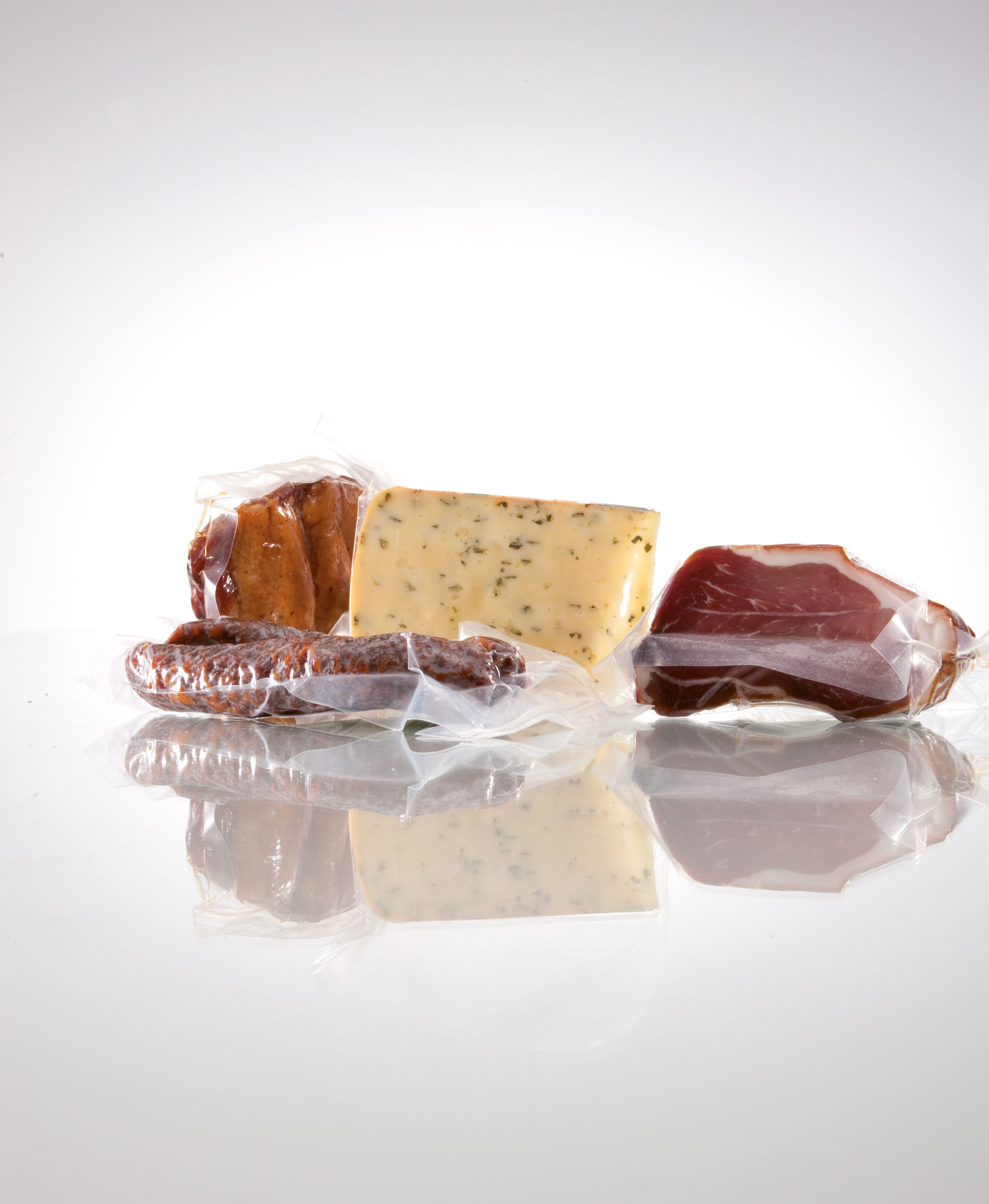
This is an advantage when vacuumising sauces and soups, but also for foods containing meat juices and marinades or for foods that are inherently moist. You do not need special film bags with a structure in the chamber vacuum cleaner to vacuum seal food.
For beam vacuumisers, you need special structured bags for vacuuming. This means that the vacuum is only pulled on one side, which can cause problems in some applications, for example if liquids are involved. One of the two films must be structured so that air channels between the upper and lower film remain free during the vacuuming process. Once the required vacuum has been reached, the top and bottom films are sealed.
The film thickness is measured in micrometres. One micrometre is equal to 0.001 millimetres and is denoted by the symbol µ. Often only the designation µ or my is used. The higher the µ, the more resistant the bag.
Bags with a film thickness of 90 µ or 140 µ are available in the ETIVERA shop. Bags with 140 µ are used for example for heavily air-dried foods such as meat. A thicker film is recommended here.
For an attractive presentation of the vacuum-packed goods, we offer practical inserts made of cardboard with a special coating.