Important information on properly sealing Twist-Off (TO) caps on jars and bottles. Twist-Off (TO) caps, also known as lug caps, were developed and designed for machine sealing.
Over-tightening the Twist-Off Cap – A Common Application Mistake
It’s often assumed that a jar or bottle needs to be closed as tightly as possible to ensure a proper seal. This approach is incorrect, however, because it bends and destroys the lugs on the cap. As a result, the spring action of the closure’s lugs becomes completely or partially ineffective. The actual sealing effect is achieved through the contact between the compound and the flat sealing surface of the jar or bottle opening. (What matters more is the correct processing temperature of the Twist-Off closure/compound — not how tightly the cap is screwed on.)
How to Do It Correctly
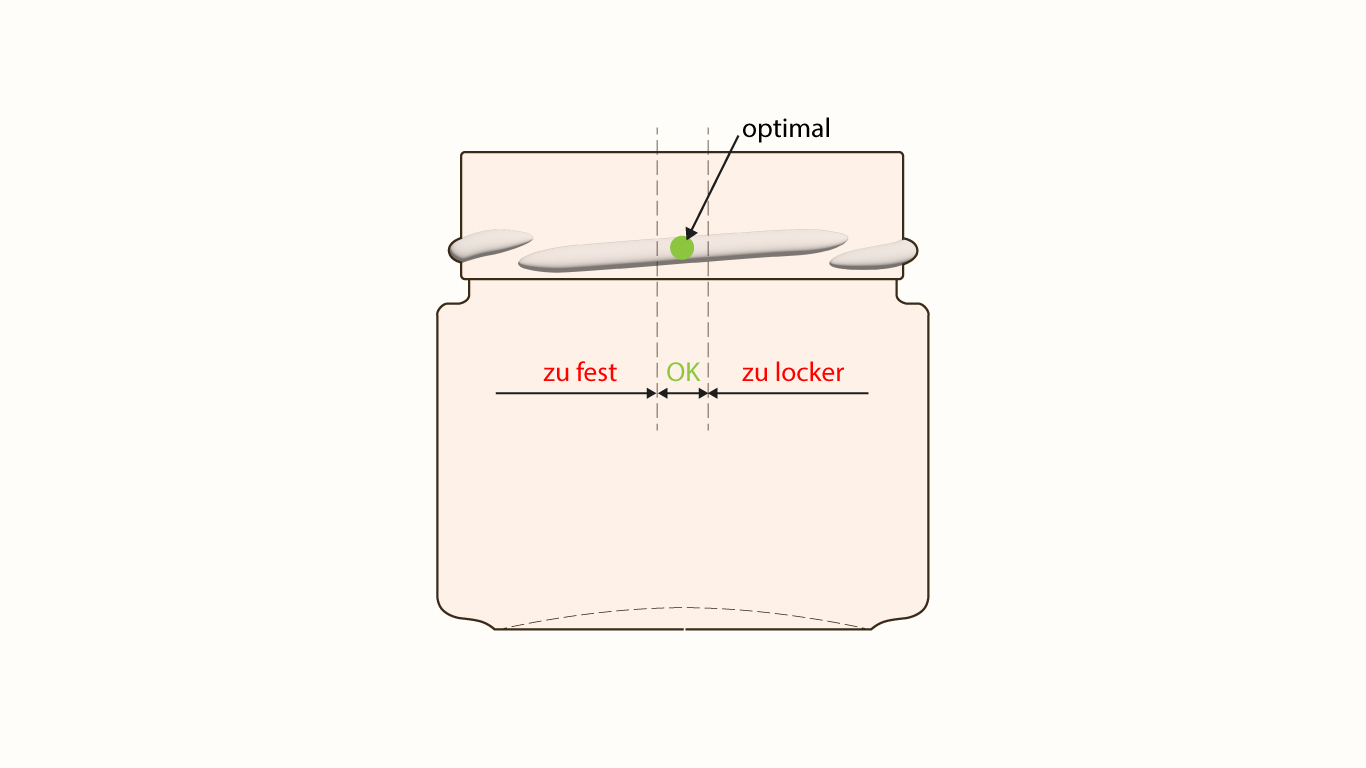
The correct approach is to position the bulge on the cap — referred to as the lug — exactly in the middle of the container’s thread run (see diagram). No unusual amount of force is required to achieve the desired result this way.